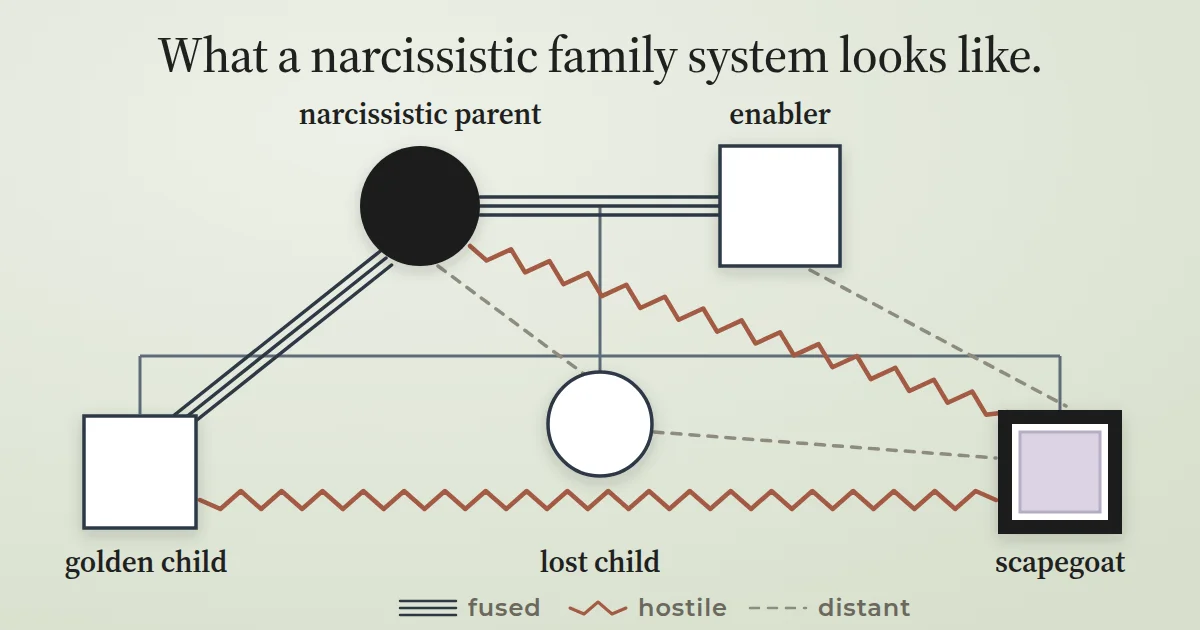
A narcissistic family is organized around one person.
In an ordinary family, the parents regulate the children. They notice what a child feels, steady it, and raise the child toward a life of their own. In a narcissistic family the direction runs the other way. The children regulate the parent.
That one inversion produces everything else.
The children learn to watch the parent’s mood, anticipate it, and adjust themselves to it, because attention, approval and safety depend on it.
The time a child would have spent finding out what they feel and want goes into managing what someone else feels.
If you grew up in one of these families, you probably already know the vocabulary. Scapegoat, golden child, enabler, flying monkeys.
What the words do not explain is why it all held together so well, and why the people who should have seen it either could not or would not.
Stephanie Donaldson-Pressman and Robert Pressman, who described the pattern in 1994, called it skewed responsibility.
The family runs on rules nobody states. What happens here is not discussed. The parent is not criticized. The image comes first. A closed door or an independent opinion is treated as disloyalty.
The rules protect one thing: the parent’s picture of themselves, and under it the shame the picture was built to cover.
Every role in the family is a job in that protection. One person absorbs and explains. One proves the picture true. One stays out of the way. One is given the job of being the problem, so that the picture never has to be.
This page describes how that system works, what it looks like from inside, who holds which job, and why the whole family defends it against the one person who says what is happening.
If your question is about the parent at the center, the 25 characteristics of a narcissistic mother covers her trait by trait, and the covert narcissistic mother covers the quiet version. If you already understand the system and want to know what to do while you are still in contact, that is how to deal with a narcissistic mother. This page is the map of the whole house.
What a narcissistic family system is
A narcissistic family system is a family in which the needs of a parent consistently come before the development of the children, and the family is arranged to keep it that way.
The parent does not have to have a diagnosis. What matters is the arrangement: one person’s self-image is the thing the household exists to protect, and everyone else’s job is defined by that.
Can a whole family be narcissistic? Usually not. There is one person at the center, sometimes two. The rest are recruited, one by one, into keeping the picture true. The recruiting is the system.
It helps to have the ordinary version in view.
In a family that works well enough, the parents hold the anxiety. The children get to be children. Needs are allowed to be visible. Disagreement is survivable. A child can be wrong, or sad, or angry, without the parent’s sense of self going down with them.
In a narcissistic family the parent cannot carry their own anxiety, so the family carries it for them.
Donaldson-Pressman and Pressman made another distinction that matters here.
Some of these families are loud: visible rage, drinking, open contempt, obvious neglect. Some are quiet: high achievement, respectability, a parent who suffers beautifully, and children who cannot say what was wrong because nothing was ever done in front of anyone.
Both kinds run on the same rules. The quiet kind is harder to see, which is its own injury.
Examples: what a narcissistic family looks like from inside
None of this looks like a system while you are living in it. It looks like your family. These are the shapes it tends to take.
The dinner table. Before anyone sits down, everyone has already read one person’s mood. The evening will be shaped by it. The children know the signs the way other children know the weather.
Nobody says this is happening. It is simply how dinner works.
The phone call afterward. You raise something, carefully, with the parent. Nothing much happens in the room. Within a day a sibling calls to say you have upset everyone, and the thing you raised has become a thing you did.
That is the system responding, not the parent. The response arrives through other people.
The performance. In public the family is warm and close. The parent is charming, the children are polite, and people say what a lovely family. In the car on the way home the temperature drops, and someone is in trouble for something that happened during the performance.
The children learn two faces before they learn long division. Jay Reid, who writes about this, explains the public warmth plainly: people outside the house rank above the people inside it, so they get the version worth protecting.
The reporter. One sibling carries news to the parent. Not maliciously, usually. It is their job, and it keeps them safe.
Nothing said inside the family is private, and everyone knows which direction information flows.
The apology that changes hands. The parent does something hurtful. By the end of the conversation you are apologizing, because the hurt was reframed as your reaction to it.
Donaldson-Pressman and Pressman noticed that these families replace reflection with reaction. There is never a moment where anyone asks what actually happened. There is only who is upset, and who caused it.
The hospital room. The parent is ill, and the illness is still about the parent’s audience. Who visited, who did not, who cried the right amount. The adult child who drove four hours is told about the one who sent flowers.
Even here the children are regulating the parent.
The will. Decades later the roles are still legible in a legal document. Who was rewarded, who was punished, and who was quietly left out.
If several of these are familiar, the pattern is familiar, whatever the details were in your house.
The rules nobody said out loud
A narcissistic family has rules the way a workplace has a culture. Nobody wrote them down. Everyone knows them.
The problem is always a person, never the system. When something goes wrong, the question is never “what is happening here?” It is “who did this?” There is always a who.
The image comes first. What the family looks like outranks what the family is. Appearances get protected the way other families protect children.
Loyalty means agreeing. Disagreement is not a point of view. It is a side, and it is the wrong one.
The parent’s feelings are the only feelings in the room. A child’s distress is heard as a complaint about the parent, and answered accordingly.
What happened did not happen. Events are revised after the fact. The child who remembers them accurately is told they are too sensitive, or dramatic, or have always had a problem with the parent.
That last rule does most of the damage.
It teaches a child not to trust their own perception. Donaldson-Pressman and Pressman called the result the cycle of learning not to trust.
Why your reaction makes sense
A child cannot survive concluding that the parent is unsafe, so the child decides the problem is themselves. Fairbairn (1952): better a sinner in a world ruled by God than a saint in a world ruled by the Devil.
Taking the blame kept the world moral and the parent good. That was the intelligent move for a child with nowhere else to go.
You did not misjudge your family; you protected yourself from what you saw.
The roles in a narcissistic family, and who does the casting
The roles in a narcissistic family are not personalities. They are jobs. The system needs certain functions filled, and children get assigned to them according to what the parent needs at the time.
In short:
- The narcissistic parent: the person whose picture of themselves the family exists to protect.
- The enabler: the other parent, who absorbs the narcissist’s distress and explains it to everyone else.
- The golden child: the child who proves the picture true.
- The scapegoat: the child who carries whatever the picture cannot hold.
- The lost child: the child who makes no demands and disappears.
- The mascot: the child who keeps everyone laughing so nobody has to feel anything.
- The relatives and friends who repeat the story: sometimes called flying monkeys.
Each one deserves a closer look, because each costs something specific.
The narcissistic parent
At the center is a person who cannot tolerate being wrong, ordinary, or seen clearly. Heinz Kohut’s term for how such a parent uses a child is self-object: the child is experienced as part of the parent, not as a separate person.
A child’s success belongs to the parent. A child’s struggle embarrasses the parent. A child’s independence threatens the parent.
Underneath the grandiosity is shame the parent cannot feel directly, so it is handled another way. Melanie Klein and later Otto Kernberg described the mechanism: splitting and projection. The good is kept, the bad is pushed outward, and the people closest to the parent are made to carry it.
That is the whole engine. Everything else in the family is downstream of it.
The enabler
The enabler is usually the other parent. They are not the narcissist, and the children often hold on to that as the one safe fact in the house.
The enabler’s job is to keep the system running.
They explain the narcissist’s behavior (“that is just how your mother is”), smooth over the damage, and ask the children to apologize so that peace returns.
Murray Bowen noticed that when one parent focuses their anxiety on a child, the other parent has three options: stay silent, take the first parent’s side, or step in and absorb the anxiety themselves.
The enabler takes the first two.
For the child, this is a second injury. The parent who could have protected them chose the marriage instead. The full version of that is on the enabling father.
The golden child
The golden child receives the parent’s idealized projection. They are special, gifted, the one who turned out right.
This looks like love. It is attention to a role.
The golden child is loved for proving the picture true, and they know somewhere that the love ends the moment they stop.
So they keep going. The pressure to perform never lets up, and the self underneath the performance never gets to show.
Pete Walker’s trauma map puts this child in the flight response: perpetually busy, perfectionist, running from the possibility of failure.
The scapegoat
The scapegoat receives the other half of the split. Whatever the parent cannot admit about themselves is located in this child.
The scapegoat is the problem. Their reactions are the issue. If only they behaved, the family would be at peace. They are the one taken to doctors and counselors so the family can say it tried.
Often the child chosen for this role is the one who saw the most and said so. Rebecca Mandeville’s research on family scapegoating found that the most perceptive child is frequently the one cast out, because perception is the threat.
This role has its own page: the family scapegoat.
The lost child
The lost child is the one nobody worried about. They needed nothing, caused nothing, and were praised, when they were noticed at all, for being no trouble.
Their adaptation was absence. Walker’s map puts them in freeze: withdrawn, self-contained, often living mostly in their head.
The cost shows up later, in adults who cannot ask for anything, who wait to be noticed and are not, and who feel like a guest in their own relationships. The glossary entry on the invisible child describes the role in more detail.
The mascot
The mascot manages the temperature. When things get tense, they are funny, charming, light. The family relaxes, and nobody has to look at why it was tense.
The adult version is a person who can make any room easier and cannot say when they are not okay.
The relatives who repeat the story
Outside the house, the system has help. Grandparents, aunts, family friends, sometimes the family’s clergy or doctor, all hear one version of events and repeat it.
They are not usually cruel. They have the public face to go on, and the public face is convincing. The narcissist’s story about the family arrives first and gets repeated, so by the time a child tries to tell a different one, the audience has already been briefed.
The roles move
One child can hold two roles. An only child tends to hold all of them in turn. And the roles switch.
The most important switch is the golden child who individuates. They choose a partner the parent did not pick, a career the parent did not approve, or simply an opinion.
The parent experiences this as a betrayal, and the splitting flips. The golden child becomes the scapegoat, sometimes overnight, and a sibling who had been overlooked is promoted.
People who went through this describe it as the floor giving way. They had done everything right for thirty years, and it turned out the love was for the role.
How the three roles play out in sons, across a lifetime, is on sons of narcissistic mothers.
In NARM terms, every one of these roles is a survival adaptation. The child became whatever the environment required, and the adaptation worked.
It also cost them access to parts of themselves: the golden child’s vigilance, the scapegoat’s bracing, the lost child’s absence from their own life.
None of that was a flaw. It was the price of staying attached to a parent who could not attach to them.
Why the whole family protects the narcissist
This is the question people carry for decades. Not why the parent did it, but why everyone else went along.
The answer is that the family is organized around protecting the parent’s picture of themselves, and under that picture is the parent’s shame.
Shame the parent cannot feel has to go somewhere. It goes into the people closest to them, and the family arranges itself so that it never has to come back.
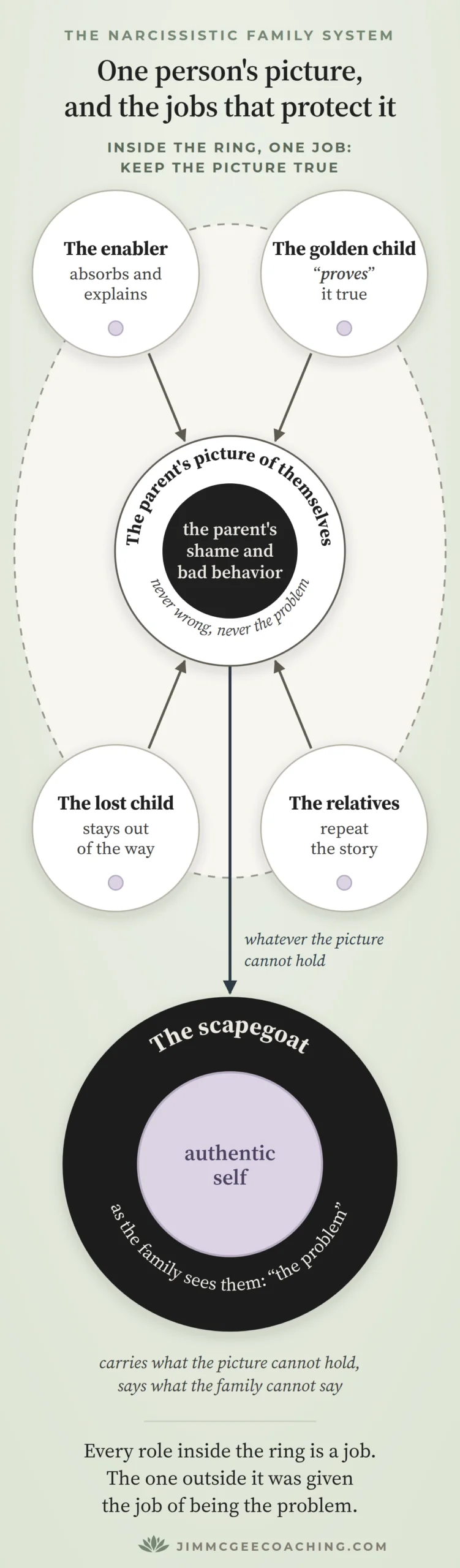
Jay Reid describes the parent’s self-image as a myth that needs constant reinforcement by the whole family to seem true.
A myth needs believers, and it needs enemies. Allies are the family members who confirm it. Enemies are the ones who threaten it. The roles are the cast list.
Each member of the family also has a stake in the story being true.
The enabler’s marriage depends on it. The golden child’s position depends on it. The relatives’ comfort depends on it. The lost child’s safety depends on staying out of it. If the scapegoat is right, every one of them has to feel what they have been avoiding.
So the scapegoat is not right. That is easier.
Not everyone holding the story up is defending it on purpose. Some are frightened. Some depend on the parent for money, housing or approval. Some have simply never seen the family any other way, and have no comparison to work from.
Bowen described how a system under strain stabilizes itself. Two people under tension recruit a third to carry it.
A parent who cannot manage their own anxiety focuses it on one child, interprets that child’s ordinary behavior as confirmation, and treats the child as the problem.
The family then has something to agree on.
Jennifer Freyd’s research on betrayal trauma explains why the believing is so complete. When seeing a truth would cost you a relationship you depend on, the mind tends not to see it. She called it betrayal blindness.
Children do it to survive. Adults in the system keep doing it to belong, and many of them never experience it as a choice.
Daniel Shaw, who studied cults after leaving one, found the same structure in families run by what he calls a traumatizing narcissist.
The followers persuade themselves that their own existence has meaning because they support the leader. Dissent is betrayal. The one who leaves is the one who was always the problem.
That is why “narcissistic family cult” is a phrase people arrive at on their own. The comparison is not an insult. It is a description of the mechanics.
The system also has an immune response.
When a member names what is happening, the family does not examine the claim. It examines the member.
Their tone, their history, their mental health, their marriage. The claim gets answered with a person.
If you call the family crazy, the family will call you crazy back.
Then come the campaign and the triangulation: relatives briefed, a sibling sent to reason with you, the sudden warmth that arrives when the pressure fails. Every one of these is the system trying to restore its balance. None of them is about you.
What this often feels like
Being outvoted on your own experience. You describe something that happened and watch a room full of people who were there agree that it did not.
After enough of that, people stop trusting the inside of their own head.
The doubt was installed; it was never evidence.
The one who could see
Every closed system needs a place to put what it cannot admit. In these families that place is a child.
The child chosen is not random, and there is more than one way to be chosen.
Some children are cast before they can talk. The parent sees something in them, a resemblance to a hated sibling, a temperament that does not flatter, a need that arrived at the wrong time, and the projection lands there and stays.
Others earn the role later, by noticing. Mandeville’s work and Reid’s both describe the child who saw the gap between what was said and what was happening, and who had the nerve or the naivety to mention it.
In that second path, seeing clearly was treated as the offense, and the role was the punishment.
The scapegoat’s accomplishments get minimized, their illnesses get doubted, their memory gets corrected, and the quality of every relationship in the family becomes their responsibility. If a parent is cruel, the scapegoat provoked it. If a sibling cuts them off, the scapegoat was difficult.
None of this is a judgment about the child. It is the job description.
The system needed a problem. It did not need the truth. The child who offered the truth was given the problem to carry instead.
What happens when you stop playing the part
People find this page at different points. Some are still inside. Some stepped back years ago and still feel the pull. Either way, it helps to know what the system does when a member stops performing.
It responds in a handful of recognizable ways. Not every family uses all of them, and not in this order.
Pressure. Guilt, obligation, the reminders of what the family has done for you.
Recruitment. Relatives call. A sibling is sent. The message is that you are hurting everyone, and that you have changed.
The story. The version of you that explains your absence gets told widely, and it is not flattering. People who have never heard your side hear it now.
Sometimes, the warmth. The parent softens. There is an invitation, a gift, a memory of good times. If the pressure did not work, the pull is tried.
And if you do not come back, the system does what systems do. It rebalances. Another member takes the vacated role, often a sibling who thought they were safe.
The double bind in all of this is worth naming once. The family says you are selfish for keeping your distance, and also that if you cared you would apologize. There is no move that satisfies both. That is because the bind is not a request. It is the system restoring its shape.
Knowing the moves does not make them painless. It does make them recognizable, and a move you recognize has less power over you.
The household moves in with you
Nobody leaves a narcissistic family at eighteen. The building stays behind; the arrangement comes along.
The golden child keeps performing for an audience that is no longer watching. The scapegoat keeps bracing for an accusation that has not arrived yet.
The lost child keeps waiting to be noticed and is not. The enabler’s child becomes the person who keeps everyone’s peace at every job they ever hold.
The body kept the training too.
Walker calls these emotional flashbacks: sudden returns to the feeling of the house, triggered by ordinary friction, with no picture attached. A tone of voice. A pause before someone answers. Being asked to explain yourself.
Many adults from these families describe an inner voice that sounds exactly like the parent and has switched to the first person. “You are selfish” became “I am selfish.”
Walker calls it the inner critic. It is the parent’s projection, kept running from inside.
What all of this does over a lifetime is the subject of adult children of narcissistic parents, and the nervous-system side of it is on post-narcissist stress disorder.
About the guilt
The thing people from these families mention most, once they understand the system, is the guilt. Not sadness. Guilt. For stepping back, for telling the truth, for wanting a life, for feeling relief.
It is worth being exact about where that comes from.
A child in a narcissistic family learns that their own direction equals abandonment.
Reid describes it this way: the scapegoated child who pursues what they want is emotionally dropped by the parent, so the child learns that meeting their own needs costs them the relationship. The golden child learns a version of the same lesson from the other side.
Wanting something of your own was the one thing the system could not allow.
So the feeling that arrives when you choose yourself is not information about whether you did something wrong. It is the alarm the family installed, going off on schedule.
That distinction matters because guilt is supposed to be useful. Real guilt follows real harm and points toward repair.
This guilt follows ordinary self-direction and points back toward the role. It has the feel of conscience and the function of a leash.
There is a simple test for which one you are feeling: who was harmed.
If the honest answer is that someone’s picture of themselves was inconvenienced, that is not harm.
People who have been out of the system a while report the same thing about this feeling. It still comes. Then it comes smaller. Then it mostly does not come, and when it does, they know what it is.
The family will call your freedom selfishness, because from inside the system that is what it looks like. From outside it looks like a person finally allowed to have a self.
Does narcissism run in families?
People ask this for two reasons. They are afraid of what they inherited, and they are afraid of what they might pass on.
The research is clearer than the fear.
Eddie Brummelman and colleagues followed several hundred children and their parents over two years and found two things that pull apart.
Parents who overvalued their children, treating them as more special and more entitled than other children, raised children who became more narcissistic. Parents who were warm raised children with higher self-esteem and no rise in narcissism.
Overvaluation raised narcissism. Warmth did not.
The study cannot say that inheritance plays no part; it was not measuring genes. What it shows is that a particular way of treating a child cultivates the trait, and that warmth does not. What this research tracks being handed down is an arrangement, and the golden child’s position is where it is most likely to pass.
Other research traces the harm rather than the trait. Parental narcissism predicts anxiety and depression in adult children largely through scapegoating, and through the anxious attachment the whole system produces. The damage travels along the roles.
Daniel Shaw’s clinical account allows for both outcomes. Some children of a traumatizing narcissist identify with the parent and become one. Many more develop the opposite: a self that is subjugated, over-attuned to others, and quick to assume fault.
No article can tell you which you are.
What can be said is this. The capacity to worry about it, to notice when you have hurt someone, feel it, and try to repair it, is the capacity the narcissistic parent did not have.
People who have it are in a different position from the one they fear. The longer answer for sons is on the sons page.
Getting free, described
Nothing here tells you what to do about your family. That decision belongs to you, and it depends on things no article knows.
What can be described is what the options are and what each one tends to cost.
Confronting means telling the family what you see and asking them to see it too. People try this first.
It rarely goes the way they hope, because the system does not examine claims; it examines claimants. Some people need to do it anyway, to know they said it.
Distance means reducing contact, or ending it. The options and their costs, from structured contact to no contact, are laid out on how to deal with a narcissistic mother and in the no contact deep dive.
Distance works when it is chosen. It works less well when it is a flight.
Acceptance means staying in some form of contact with no expectation that the system will change, and no further attempts to be understood by it.
It sounds like giving up. For many people it is the first restful position they have ever held in relation to their family.
One distinction runs under all three, and Bowen named it. Leaving a family is not the same as getting free of it.
A person who runs from the system still carries the reactivity, and tends to recreate the same shapes in the next relationship.
What changes things is differentiation: the capacity to hold your own perception in the presence of people who do not share it, without attacking and without caving.
That can happen at any level of contact, or none.
Important distinction
Cutting off in a panic and stepping back on purpose can look identical from outside, and inside they are opposites. One is the system still running you from a distance; the other is you.
The question is not how far away you are but who is deciding.
A practical note about family therapy, from what people bring me rather than from a study. Joint sessions with the narcissistic parent in the room tend to go badly.
The parent performs well for an hour, the child who has been living in it looks like the unstable one, and anything disclosed gets used at home afterward.
The people I know who got real help with this got it for themselves.
What tends to help, in my experience with the people I work with and with the group I have sat with every week for four years, is slower and plainer.
Being seen accurately by one other person. Learning to tell the installed alarm from real conscience.
Letting the grief come, because the truth about the family arrives with a loss attached: the family you did not have, and the years spent trying to earn it.
Building a life with people who do not need you to play a part.
Dropping the role is harder than it sounds and more possible than it feels.
Where your power actually lies
The system needs its members in position, and it cannot make anyone stay there. A role is something a person was given, and a thing a person was given can be put down.
They can keep the story; it only works on people who are still in it.
What becomes possible
People who grew up in these families describe the same first signs that something has changed.
Someone is irritated with them and nothing happens in the body.
They say no to a holiday and the guilt arrives, and they recognize it, and it passes.
A sibling calls with the family’s version of events, and they listen, and do not argue, and do not take it in.
They notice that they wanted something, and had it, and nobody was harmed.
None of this requires the family to change, understand, or apologize. The parent at the center will most likely keep the picture until the end. The family will most likely keep protecting it.
What changes is that you are no longer one of the people holding it up, and the self that was underneath the role turns out to have been there the whole time.
The role was given to you. It was never a description of you, and there is a life on the other side of it.
Frequently asked questions
What is a narcissistic family system?
A narcissistic family system is a family organized around one parent’s need to be admired, obeyed and never seen as wrong. The parent’s needs come before the children’s development, and every other member is assigned a role that protects the parent’s self-image. Donaldson-Pressman and Pressman described it in 1994 and called the core problem skewed responsibility: the children regulate the parent instead of the other way round.
What are examples of a narcissistic family system?
A household where everyone reads one person’s mood before dinner. A family that is warm in public and cold in the car on the way home. A child who raises a concern and is told by a sibling the next day that they have upset everyone. An apology that starts as the parent’s and ends as the child’s. A will that reflects the family roles decades later. The common thread is that one person’s image is protected and a child pays for it.
What are the roles in a narcissistic family?
The narcissistic parent at the center; the enabler, who absorbs and explains; the golden child, who proves the parent’s picture true; the scapegoat, who carries the blame; the lost child, who disappears; the mascot, who keeps things light; and the relatives and friends who repeat the parent’s version of events. One child can hold more than one role, and the roles switch, most often when a golden child asserts independence and is demoted.
Why do narcissistic families act like a cult?
Because the structure is the same. There is a leader whose image cannot be questioned, followers whose standing depends on agreeing, an us-against-them story about outsiders, and a rule that whoever leaves was always the problem. Daniel Shaw, who studied cults after leaving one, found the same dynamics in families run by a traumatizing narcissist.
Why does the whole family side with the narcissist?
Each member has a stake in the parent’s story being true: the enabler’s marriage, the golden child’s position, the relatives’ comfort, the lost child’s safety. Believing the scapegoat would cost all of them something. Many are not defending the parent deliberately; they are frightened, dependent, or have never seen the family any other way. Jennifer Freyd’s work on betrayal blindness describes how people stop seeing a truth when seeing it would threaten a relationship they depend on.
Can a whole family be narcissistic?
Usually there is one narcissistic parent, sometimes two. The rest of the family is recruited into protecting that person, which can make the whole family behave narcissistically toward one member without each person being a narcissist. When both parents are narcissistic the system has no counterweight at all, and children from those homes often describe learning very early that relying on anyone was dangerous.
Do narcissists care about their family?
They care about the family as an image and as a source of attention. Members are valued for what they provide: admiration, compliance, a good reflection. Care for a child as a separate person, with needs that compete with the parent’s, is what the system is built to avoid.
Does narcissism run in families?
What the research has measured being passed down is an arrangement rather than a gene. Brummelman and colleagues found that parental overvaluation, treating a child as more special and entitled than others, raised narcissism in children over time, while parental warmth raised self-esteem without it. Children of narcissistic parents can go either direction. The ability to notice harm you have done, feel it, and repair it is the capacity the narcissistic parent lacked.
What happens when the scapegoat leaves?
The system tries to pull them back, in some combination of: guilt and obligation, relatives recruited to apply pressure, a story about the scapegoat told widely, and sometimes sudden warmth. If none of that works, the family rebalances and another member, often a sibling who thought they were safe, is moved into the vacated role.
Can one person hold more than one role?
Yes. Roles are functions, not identities. A child can be the golden child to one parent and the scapegoat to the other, or hold both roles at different ages. Only children often hold every role in turn. The role a person was given says something about what the system needed and nothing about who they are.
References
The sources this page draws on, in roughly the order it uses them.
- Donaldson-Pressman, S., & Pressman, R. M. (1994). The Narcissistic Family: Diagnosis and Treatment. Lexington Books (paperback, Jossey-Bass, 1997). (Skewed responsibility; overt and covert systems; reactive versus reflective; the cycle of learning not to trust.)
- Reid, J. (2023). How to bust the myth of the narcissistic parent’s superiority. Jay Reid Psychotherapy. (Section “Mythical allies and enemies in the narcissistic family”: the parent’s myth of superiority and the family recruited to reinforce it.) jreidtherapy.com
- Reid, J. (2023). How Scapegoats Can Heal from Narcissistic Abuse. (Neither child allowed to be separate; self-direction experienced as abandonment.)
- Fairbairn, W. R. D. (1952). Psychoanalytic Studies of the Personality. Routledge. (The moral defense.)
- Kohut, H. (1971). The Analysis of the Self. International Universities Press. (The self-object.)
- Kernberg, O. F. (1975). Borderline Conditions and Pathological Narcissism. Jason Aronson. (Splitting, projective identification, pathological envy.)
- Bowen, M. (1978). Family Therapy in Clinical Practice. Jason Aronson. (Triangles, the family projection process, differentiation of self, emotional cutoff.)
- Freyd, J. J. (1996). Betrayal Trauma: The Logic of Forgetting Childhood Abuse. Harvard University Press. (Betrayal blindness.)
- Shaw, D. (2014). Traumatic Narcissism: Relational Systems of Subjugation. Routledge. (The traumatizing narcissist; cults and families; the subjugated self and identification with the aggressor.) Taylor & Francis
- Mandeville, R. C. (2020). Rejected, Shamed, and Blamed: Help and Hope for Adults in the Family Scapegoat Role. (Family scapegoating abuse; the perceptive child as the one cast out.)
- Walker, P. (2013). Complex PTSD: From Surviving to Thriving. Azure Coyote. (The four F responses; emotional flashbacks; the inner critic.)
- Brummelman, E., Thomaes, S., Nelemans, S. A., Orobio de Castro, B., Overbeek, G., & Bushman, B. J. (2015). Origins of narcissism in children. Proceedings of the National Academy of Sciences, 112(12), 3659 to 3662. (Overvaluation predicts child narcissism; warmth predicts self-esteem.) DOI
- Vignando, M., & Bizumic, B. (2023). Parental narcissism leads to anxiety and depression in children via scapegoating. The Journal of Psychology, 157(2), 121 to 141. (Scapegoating as the pathway from parental narcissism to adult anxiety and depression.) DOI
- Hewitt, J. M. A., Kealy, D., Hewitt, P. L., Ko, A., Chen, C., Brugnera, A., Madigan, S., & Birch, S. (2024). Parental pathological narcissism and child depression: The indirect effects of child attachment and perspective taking. Current Psychology, 43(19), 17039 to 17048. (Transmission through child attachment anxiety over one year.) DOI
- Wegscheider-Cruse, S. (1981). Another Chance: Hope and Health for the Alcoholic Family. Science and Behavior Books. (The original family roles, later adapted to narcissistic systems.)
- Heller, L., & LaPierre, A. (2012). Healing Developmental Trauma. North Atlantic Books. (Survival adaptations; the NARM frame.)
What this work is
You may have the whole map: narcissistic abuse, scapegoating, CPTSD, the names for all of it. And still live organized around shame, self-doubt, and the quiet sense that something is wrong with you.
Insight alone doesn’t tell the nervous system it’s safe. Understanding what happened is not the same as no longer living from it.
NARM-informed coaching is the slow, relational work that comes after understanding, where the old protections finally get to stand down, and the self that was there before you had to adapt can come forward again.
Schedule a Free ConversationPrivate NARM-informed coaching. Not licensed psychotherapy or crisis care.