
You could never prove it and that was by design.
In 2007 a woman named Chris published this list, and the original source has since disappeared from the internet. I’m republishing it here because the writing was so great, and I added some tie-ins to known dynamics.
The Destructive Narcissistic Parent creates a child that only exists to be an extension of her self.
It’s about secret things.
It’s about body language.
It’s about disapproving glances.
It’s about vocal tone.
It’s very intimate.
And it’s very powerful.
Chris
Under each passage is a short note on what was happening underneath, and the longer commentary stays folded until you want it.
I am a coach, and I work with adults who grew up under these circumstances.
1. Everything she does is deniable
Everything she does is deniable. There is always a facile excuse or an explanation. Cruelties are couched in loving terms. Aggressive and hostile acts are paraded as thoughtfulness. Selfish manipulations are presented as gifts. Criticism and slander is slyly disguised as concern.
She only wants what is best for you. She only wants to help you.
She rarely says right out that she thinks you’re inadequate.
Instead, any time that you tell her you’ve done something good, she counters with something your sibling did that was better or she simply ignores you or she hears you out without saying anything, then in a short time does something cruel to you so you understand not to get above yourself.
She will carefully separate cause (your joy in your accomplishment) from effect (refusing to let you borrow the car to go to the awards ceremony) by enough time that someone who didn’t live through her abuse would never believe the connection.
It is impossible to confront someone over their tone of voice, their demeanor or they way they look at you, but once your narcissistic mother has you trained, she can promise terrible punishment without a word.
As a result, you’re always afraid, always in the wrong, and can never exactly put your finger on why.
Chris, 2007
Go deeper: what was happening, and the clinical picture
Deniability is the requirement everything else is built around. So the punishment arrives days after the crime of being happy, the congratulation arrives in a voice that means the opposite of the word, and the look crosses her face and is gone before anyone else turns around.
What this does to a child is specific. The nervous system reads a face long before the mind can think about it, and it read hers right. But a child cannot point to a look.
That split, between a body that knows and a mind with nothing to show, is where self-doubt is installed. Years later you do her job for her; the glossary calls that self-gaslighting.
The psychoanalyst Daniel Shaw describes the traumatizing narcissist as someone who cannot tolerate her own shame and dependency and keeps them “out there” by arranging for someone else to carry them.
The child is the ideal host, and deniability is what lets the transfer happen without her ever appearing to be the one doing it (Shaw, 2014).
The body’s side is what Stephen Porges named neuroception: the below-conscious scan that answers “safe or dangerous” from a face, a tone, a silence. The “promise of terrible punishment without a word” above is neuroception doing its job on a signal that was really there.
Jennifer Freyd’s work on betrayal blindness adds the last piece. A child who depends on the person betraying her has every reason not to register the betrayal. Deniability gives that blindness something to hold on to.
2. She violates your boundaries
She violates your boundaries. You feel like an extension of her. Your property is given away without your consent, sometimes in front of you. Your food is eaten off your plate or given to others off your plate.
Your property may be repossessed and no reason given other than that it was never yours. Your time is committed without consulting you, and opinions purported to be yours are expressed for you. (She LOVES going to the fair! He would never want anything like that. She wouldn’t like kumquats.) You are discussed in your presence as though you are not there.
You have never known what it is like to have privacy in the bathroom or in your bedroom, and she goes through your things regularly. She asks nosy questions, snoops into your email/letters/diary/conversations.
She will want to dig into your feelings, particularly painful ones and is always looking for negative information on you which can be used against you.
Any attempt at autonomy on your part is strongly resisted.
Normal rites of passage (learning to shave, wearing makeup, dating) are grudgingly allowed only if you insist, and you’re punished for your insistence (“Since you’re old enough to date, I think you’re old enough to pay for your own clothes!”)
If you demand age-appropriate clothing, grooming, control over your own life, or rights, you are difficult and she ridicules your “independence.”
Go deeper: what was happening, and the clinical picture
The glossary calls being treated as a thing with no inside that has to be consulted objectification. It is not that she decided your privacy did not matter. It is that, to her, you did not have the kind of interior where privacy would live.
The clinicians call the work of becoming separate separation-individuation. Margaret Mahler’s research (Mahler, Pine and Bergman, 1975) describes the toddler’s two-part discovery: I am separate, and I can be separate and still loved. A narcissistic parent interrupts the second half. The child learns separateness, but learns it as a crime.
Shaw frames the result as a structural double bind: the child’s needs are shamed as “dependency,” and her moves toward independence are punished as abandonment. “Unable to be anything but dependent, yet still attempting independence, the child of the traumatizing narcissist parent is condemned either way” (Shaw, 2014).
For a son, whose body and time belonged to her first, it can show up as a man who genuinely cannot locate a want that is his. The glossary’s entry on enmeshment describes the residue; Anat Talmon and Karni Ginzburg’s self-objectification scale measures it, and finds that invisibility and lack of autonomy carry much of the link between childhood maltreatment and adult shame (Talmon and Ginzburg, 2016). Being treated as an object in childhood becomes treating yourself as one.
3. She plays favorites
Narcissistic mothers commonly choose one child to be the golden child and one to be the scapegoat. The narcissist identifies with the golden child and provides privileges to him or her as long as the golden child does just as she wants.
She attempts to replicate herself in the golden child. The golden child has to be cared for assiduously by everyone in the family. The scapegoat has no needs and instead gets to do the caring, or is ignored, or is harmed. The golden child can do nothing wrong.
The scapegoat is always at fault.
This creates divisions between the children, one of whom has a large investment in the mother being wise and wonderful, and the other(s) who hate her. That division will be fostered by the narcissist with lies and with blatantly unfair and favoritizing behavior.
The golden child will defend the mother and indirectly perpetuate the abuse by finding reasons to blame the scapegoat for the mother’s actions.
Go deeper: what was happening, and the clinical picture
Psychoanalysts since Melanie Klein have called the underlying move splitting: keep good and bad apart, because holding them together is unbearable (Klein, 1946). In a narcissistic family the split is externalized onto the children.
Family therapists describe how a parent’s own anxiety gets focused onto one child, who grows up carrying a problem that was never theirs: the family projection process (Bowen, 1978).
The scapegoat carries the shame. The golden child carries the image, and pays in a different currency: praise for being a reflection, a worth that was never unconditional, and a quiet sense of being a fraud that makes no sense from the outside.
Rebecca Mandeville describes the scapegoated child as a “human movie screen” for the family’s unconscious projections (Mandeville, 2020).
The roles can rotate, and the siblings are set against each other by design.
Jay Reid’s work with scapegoat survivors notes that the roles are interdependent: the golden child’s identity is partly defined by not being the scapegoat, which is why a scapegoat who leaves can destabilize the whole arrangement.
The scapegoat, who often sees the family most accurately, ends up the least believed.
The glossary’s entry on conditional worth names what both children learn: the right to be loved has to be earned, and can be lost. If you were a son, the three roles have their own shape, and I have written about how they land on boys.
4. She undermines
Your accomplishments are acknowledged only to the extent that she can take credit for them. Any success or accomplishment for which she cannot take credit is ignored or diminished.
Any time you are to be center stage and there is no opportunity for her to be the center of attention, she will try to prevent the occasion altogether, or she doesn’t come, or she leaves early, or she acts like it’s no big deal, or she steals the spotlight or she slips in little wounding comments about how much better someone else did or how what you did wasn’t as much as you could have done or as you think it is.
She undermines you by picking fights with you or being especially unpleasant just before you have to make a major effort.
She will be nasty to you about things that are peripherally connected with your successes so that you find your joy in what you’ve done is tarnished, without her ever saying anything directly about it. No matter what your success, she has to take you down a peg about it.
Go deeper: what was happening, and the clinical picture
Klein’s late work, Envy and Gratitude (1957), defines envy as the angry awareness that someone else possesses something good, paired with the impulse to spoil it.
Contemporary relational analysts reject her idea that envy is innate and see it as a defense born of early deprivation; her account of the spoiling mechanism is still standard. The clinicians who work with scapegoat survivors describe the pattern precisely: a child punished “suspiciously soon after a success.”
The child notices the sequence long before they can name it, and draws the only sensible conclusion. The glossary calls the adult version playing small: reducing your visibility, ambition and voice before anyone has to ask. Its cousin is self-sabotage, the thing you do at the exact moment something is about to go well.
Jay Reid describes the sequence from the child’s side: the parent’s envy is relieved when the child’s gift is deflated, so the child learns to deny their gifts as a form of protection. “Sure it is painful but it beats being attacked all the time.”
Shaw cites Sheldon Bach’s observation that the inflated narcissist “can experience himself as cohesive and alive only at the expense of devitalizing his objects” (Shaw, 2014). Your success made her feel less alive. That was never your problem to solve.
5. She demeans, criticizes and denigrates
She lets you know in all sorts of little ways that she thinks less of you than she does of your siblings or of other people in general.
If you complain about mistreatment by someone else, she will take that person’s side even if she doesn’t know them at all. She doesn’t care about those people or the justice of your complaints. She just wants to let you know that you’re never right.
She will deliver generalized barbs that are almost impossible to rebut (often in a caring tone): “You were always difficult” “You can be very difficult to love” “You never seemed to be able to finish anything” “You were very hard to live with” “You’re always causing trouble” “No one could put up with the things you do.”
She will deliver slams in a sidelong way; for example she’ll complain about how “no one” loves her, does anything for her, or cares about her, or she’ll complain that “everyone” is so selfish, when you’re the only person in the room.
As always, this combines criticism with deniability.
She minimizes, discounts or ignores your opinions and experiences. Your insights are met with condescension, denials and accusations (“I think you read too much!”) and she will brush off your information even on subjects on which you are an acknowledged expert.
Go deeper: what was happening, and the clinical picture
Pete Walker puts it this way: “Parental contempt is the key piece of the emotional abuse that creates toxic shame.” He describes the inner critic as a process rather than a recording, one that “co-opts our creativity and funnels it into new and improved ways of imitating our parents’ disparagement” (Walker, 2013). Clients report calling themselves names their mother never used, in her voice.
That is how it starts: if the child can find the flaw before she does, maybe the blow can be softened. Over years, shame stops being a feeling that visits and becomes the ground you stand on. The glossary calls that shame-based identity.
Laurence Heller’s recent work frames shame as an ongoing activity rather than a stored feeling. The child’s system keeps generating shame because shame was once the safest state to be in (Heller and Niederwieser, 2026). That reframe matters for recovery, because an activity can be interrupted.
The glossary entries on belittlement and invalidation describe the two channels in the passage above: the direct chip at your worth, and the sustained message that your feelings are wrong or not happening.
6. She makes you look crazy
If you try to confront her about something she’s done, she’ll tell you that you have “a very vivid imagination” (this is a phrase commonly used by abusers of all sorts to invalidate your experience of their abuse), that you don’t know what you’re talking about, or that she has no idea what you’re talking about.
She will claim not to remember even very memorable events, flatly denying they ever happened, nor will she ever acknowledge any possibility that she might have forgotten.
Your perceptions of reality are continually undermined so that you end up being extremely confused, and wondering if you are as she says you are; usually, you will begin to believe deeply her lies about you.
You will end up without any confidence in your intuition, your memory or your powers of reasoning. This makes you a much better victim for the narcissistic abuser.
You’re oversensitive. You’re imagining things. You’re hysterical. You’re completely unreasonable. You’re over-reacting, like you always do. She’ll tell you that she’ll talk to you when you’ve calmed down and aren’t so irrational.
She has simultaneously absolved herself of any responsibility for your obvious antipathy towards her, implied that it’s something fundamentally wrong with you that makes you angry with her, and undermined your credibility with her listeners. She plays the role of the doting mother so perfectly that no one will believe you.
Go deeper: what was happening, and the clinical picture
There are two audiences here. To you, in private: that never happened, you imagine things, you’re too sensitive. To everyone else, in public: concern, worry, the sad shake of the head about your “problems.”
By the time you try to speak, the room has already heard the other version. Daughters got “hysterical.” Sons got “angry,” which did the same job on a boy.
The glossary’s entry on gaslighting covers the tactic; crazy-making describes the felt result, coming out of an ordinary conversation foggy, drained and somehow apologizing.
Philosophers have a name for the harm of not being treated as a credible witness to your own life: epistemic injustice. Miranda Fricker’s Epistemic Injustice (2007) names testimonial injustice, a hearer’s prejudice deflating a speaker’s credibility; the “concern” campaign is testimonial injustice manufactured in advance.
Peter Fonagy’s concept of epistemic trust describes how a child learns whom to believe about the world: the people who seem to see them accurately.
A parent who sees the child only as an extension of herself breaks that trust at the root, which is one reason adult survivors swing between trusting no one and trusting the wrong people (see mentalization and epistemic trust).
A useful distinction from the clinical literature: ordinary disagreement comes with curiosity and respect for the other person as a knower. Gaslighting comes with a unilateral demand that you adopt her version, delivered with contempt or the threat of withdrawal. The second one is not a memory dispute.
7. She’s extremely envious
Any time you get something nice she’s angry and envious and her envy will be apparent when she admires whatever it is. She’ll try to get it from you, spoil it for you, or get the same or better for herself.
She’s always working on ways to get what other people have. The envy of narcissistic mothers often includes competing sexually with their daughters or daughters-in-law. They’ll attempt to forbid their daughters to wear makeup, to groom themselves in an age-appropriate way or to date.
Or they will encourage you to present yourself in a sexually provocative way, and then they will directly compete with you for male attention. They will criticize the appearance of their daughters and daughters-in-law, no matter what their appearance is like. This envy extends to relationships.
Narcissistic mothers infamously attempt to damage their children’s marriages and interfere in the upbringing of their grandchildren.
Go deeper: what was happening, and the clinical picture
Envy of the daughter-in-law is a predictable feature of this landscape, and few people warn the son.
Daniel Shaw’s reading is that the traumatizing narcissist cannot tolerate being surpassed or being unneeded; Jay Reid observes that a narcissistic parent may especially envy the other parent’s capacity to love, and will denigrate it as weakness. The same envy is aimed at a child’s partner.
There is a darker reading in the literature, and some readers will recognize it. A parent who cannot find vitality in herself borrows the child’s.
Jean Knox, writing from an attachment and neuroscience perspective, describes the child who learns “there is only one mind, the parent’s, whose needs and desires are always paramount,” and who comes to experience separateness itself as bad, “with a quality of absolute certainty” (Knox, 2011).
Any sign of the child’s own aliveness is met with what she calls an envious attack.
Klein’s envy is paradoxical: it is triggered by the good object, not the bad one, because the good in someone else’s possession exposes one’s own lack (Klein, 1957). In a narcissistic mother the “good object” is her own child’s life. The glossary’s entries on the devouring mother and on narcissistic injury explain why your good fortune registers, to her, as a wound.
8. She’s a liar in too many ways to count
The narcissist is very careful about how she lies. To outsiders she’ll lie thoughtfully and deliberately, always in a way that can be covered up if she’s confronted with her lie. She spins what you said rather than makes something up wholesale.
She puts dishonest interpretations on things you actually did. If she’s recently done something particularly egregious she may engage in preventative lying: she lies in advance to discount what you might say before you even say it.
If you do try to take action to expose her lies, you will look like the one with ‘the problem’ as she has carefully cultivated others to believe you are.
The more emotional or dramatic you become in trying to have others see the truth of how you are treated by her, the more unbalanced you will look and the more solid will become their agreement with her subtle assessment of you that she’s planted into them.
To you, she’ll lie blatantly. She will claim to be unable to remember bad things she has done, even if she did one of them recently and even if it was something very memorable.
Your conversations with her are full of casual brush-offs and diversionary lies and she doesn’t respect you enough to bother making it sound good.
You are now in a game with only one rule: You can’t win.
Go deeper: what was happening, and the clinical picture
The glossary describes the blatant lie as maintaining the one-up position. The preventative lie is the piece to understand: before you ever speak, the audience has been seated and briefed. The glossary calls the campaign version a smear, and the research is consistent: a listener primed in advance hears the later disclosure through the prime. The more you push to be believed, the more you look like what she said you were.
What this leaves in an adult is often a courtroom in the head: over-explaining, over-documenting, writing the long text that proves the point and loses the person. The glossary has an acronym for the instinct, JADE, and a gentler word for what it costs.
Shaw’s term for this environment is hegemony of subjectivity: a relational world in which only one person’s version of reality is permitted to exist, and the other person’s is steadily overruled until she stops trusting it herself (Shaw, 2014).
Freyd’s experimental work on DARVO found that exposure to the perpetrator’s reversal measurably lowers third parties’ belief in the victim and raises the victim’s self-blame (Harsey and Freyd, 2020). Preventative lying is the same effect, run before the confrontation instead of after.
The glossary distinguishes lying as a tactic, deception used to control, from pathological lying, where it has become structural. The heading, too many ways to count, suggests both were in the house.
9. She has to be the center of attention all the time
This need is a defining trait of narcissists and particularly of narcissistic mothers for whom their children exist to be sources of attention and adoration. Narcissistic mothers love to be waited on and often pepper their children with little requests.
“While you’re up…” or its equivalent is one of their favorite phrases.
You couldn’t just be assigned a chore at the beginning of the week or of the day, instead, you have to do her wishes on demand, preferably at a time that was inconvenient for you, or you had to “help” her do it, while she quietly glories in the command and control she wields over you.
For a narcissist, it is always, and only, about them. Your primary function is to satisfy their needs and wants.
If she visits you or you visit her, you are required to spend all your time with her, doing as she wants. Entertaining herself is unthinkable.
She has always pouted, manipulated or raged if you tried to do anything without her, didn’t want to entertain her, refused to wait on her, stymied her plans for a drama or otherwise deprived her of attention.
This gives them the opportunity to cash in on the investment they made when they trained you to wait on them as a child.
Go deeper: what was happening, and the clinical picture
Donald Winnicott’s 1967 paper on the mirror role of the mother describes the infant looking at the mother’s face and seeing himself there. When the mother’s face reflects only her own mood, “the baby looks and does not see himself.”
Heinz Kohut’s term for a person used this way is a selfobject: not experienced as a separate person but as a function that regulates the narcissist’s self-esteem (Kohut, 1971).
The glossary’s word for the fuel is narcissistic supply: the steady stream of attention a narcissist needs to keep the inflated image from deflating. A child is the most reliable source there is, because a child cannot leave.
The pattern of small demands on your time is what Evan Stark, in his work on coercive control, calls micro-regulation: control exercised through the trivial, continuously, so that it never looks like control (Stark, 2007).
Then there is the aging drama. Adult children carry a lot of guilt about this one. A mother who trained you to wait on her as a child is, in the essay’s phrase, cashing in the investment. The need is real.
The use of the need is also real. Both things are true, and seeing the second does not make you heartless. The glossary’s entry on objectification describes the end state: a person treated as useful or not useful, never as someone with an inside that has to be consulted.
10. She manipulates your emotions in order to feed on your pain
She does and says things just to be wounding or she engages in tormenting teasing or she needles you about things you’re sensitive about, all the while a smile plays over her lips.
She may have taken you to scary movies or told you horrifying stories, then mocked you for being a baby when you cried. She will slip a wounding comment into conversation and smile delightedly into your hurt face.
She wants you to know that your pain entertains her. She may also bring up subjects that are painful for you and probe you about them, all the while watching you carefully. This is emotional vampirism in its purest form. She’s feeding emotionally off your pain.
She enjoys your pain. This may be the hardest aspect of the character of mothers with narcissistic personality disorder to believe and accept. After all, she is your mother.
She sobs and wails that no one loves her and everyone is so selfish, and she doesn’t want to live, she wants to die! She wants to die!
Go deeper: what was happening, and the clinical picture
The analyst Emmanuel Ghent described patients who could say “my mother was sadistic,” list the evidence, and end with “but somehow I can’t believe it’s true.”
His 1990 paper contains the passage on “the apperception of disorganizing meaning”: if a perception threatens a belief, either the belief or the perception has to go (Ghent, 1990). For a child it was never going to be the belief.
He proposes that some people recreate the painful situation again and again not to master it but to finally perceive it.
The mechanism has a name. The glossary describes projective identification as the place where feelings get transplanted: an unbearable state in her, her own smallness, her terror, her shame, is put into you, and then watched there.
Your distress is, for a moment, proof that the badness lives in you and not in her.
Thomas Ogden’s three-phase account (1979) describes the projector placing the state into the other, applying pressure until the other feels it, then relating to them as the one who has it; in abusive dynamics the recipient is kept as a permanent container.
Not every narcissistic mother does this. This is the severe end, what the glossary calls the traumatizing narcissist, where the cruelty has a sadistic edge.
Otto Kernberg’s description of malignant narcissism includes ego-syntonic sadism, pleasure in inflicting pain that the person does not experience as wrong (Kernberg, 1984). The “little smile” above is a layperson’s exact observation of it.
What it leaves behind is the rule “never show her it hurts,” which generalizes, silently, into “never show anyone.” The glossary calls the long-run cost emotional numbness. It was a reasonable rule in that house. It is costing you now.
11. She’s selfish and willful
She insists on having her own way all the time and she will ruthlessly, manipulatively pursue it, even if what she wants isn’t worth all the effort she’s putting into it and even if that effort goes far beyond normal behavior.
She will make a huge effort to get something you denied her, even if it was entirely your right to do so and even if her demand was selfish and unreasonable.
If you tell her she cannot bring her friends to your party she will show up with them anyway, and she will have told them that they were invited so that you either have to give in, or be the bad guy to these poor dupes on your doorstep.
If you tell her she can’t come over to your house tonight she’ll call your spouse and try get him or her to agree that she can, and to not say anything to you about it because it’s a “surprise.”
She has to show you that you can’t tell her “no.”
One near-universal characteristic of narcissists: because they are so selfish and self-centered, they are very bad gift givers. They’ll give you hand-me-downs or market things for themselves as gifts for you (“I thought I’d give you my old bicycle and buy myself a new one!” “I know how much you love Italian food, so I’m going to take you to my favorite restaurant for your birthday!”)
She’ll make it clear that it pains her to give you anything.
Go deeper: what was happening, and the clinical picture
The glossary describes entitlement as the fixed belief that the ordinary rules of give and take do not apply to you, and a no from your own child is the most direct challenge to that belief there is.
So she goes around it: through your spouse, through your doorstep, through the friends she told were invited. The size of the issue has nothing to do with the size of the campaign.
Kohut’s narcissistic injury explains the disproportion. Because the narcissist experiences the other person as an extension of herself, any independent act by that person is felt as a loss of control; a refused dinner invitation produces a response sized for a betrayal (Kohut, 1972).
The NARM clinicians describe a child in this position developing a hidden no underneath a compliant yes.
Heller and LaPierre’s account of the autonomy survival style: the child “superficially goes along with the parents’ program while internally reacting to the control by secretly holding out” (Heller and LaPierre, 2012). It kept something of you intact. It also made saying a plain no feel dangerous.
The glossary’s entry on healthy entitlement describes what grows back when this loosens: the ordinary permission to take up the space a person is allowed, including the space of a no.
12. She’s self-absorbed, totally self-centered
Her feelings, needs and wants are very important; yours are insignificant to the point that her least whim takes precedence over your most basic needs. Her problems deserve your immediate and full attention; yours are brushed aside.
Her wishes always take precedence; if she does something for you, she reminds you constantly of her munificence in doing so and will often try to extract some sort of payment. She will complain constantly, even though your situation may be much worse than hers.
If you point that out, she will effortlessly, thoughtlessly brush it aside as of no importance (It’s easy for you…/It’s different for you…). If you refuse to give her the attention that she demands, she may cut you off and ignore you outright.
Go deeper: what was happening, and the clinical picture
Daniel Shaw’s phrase for this is the one the glossary uses, hegemony of subjectivity. Shaw: the traumatizing narcissist’s “goal is to corrupt and debilitate the subjectivity of the other, a form of dehumanization that is the very essence of traumatic abuse” (Shaw, 2014).
The quieter version, the mother who simply never registers that you have an inside, achieves much of the same effect without raising her voice. The glossary describes the end point as loss of subjectivity: your inner life stops being allowed to belong to you.
The NARM clinicians call the adult pattern the attunement survival style: a child so practiced at reading others’ needs, because survival depended on it, that their own needs went dark.
Heller and LaPierre describe these people as “the givers of the world, the shoulder on which everyone cries,” over-represented in the helping professions (Heller and LaPierre, 2012). The attunement is real, and it is a gift. The darkness is the cost.
Leonard Shengold’s older term for the extreme end of this, soul murder, describes abuse and deprivation that destroy a child’s capacity for joy and for a separate identity (Shengold, 1989). It is strong language. For some readers of this page it is also accurate.
13. She is insanely defensive and is extremely sensitive to any criticism
If you criticize her or defy her she will explode with fury, threaten, storm, rage, destroy and may become violent, beating, confining, putting her child outdoors in bad weather or otherwise engaging in classic physical abuse and emotional abuse.
It’s easy to provoke her wrath because she takes everything personally and any attitude short of constant emotional and physical availability is perceived as a slight. If you’re short with her because you’re exhausted and depressed, she has to have it out with you over your “hostility.”
If a toddler shouts “I hate you” at her she gets angry and punitive; punishment is payment and is often cruel and way out of proportion to the event.
If you refuse her nosy request to let her read the letter you got she shouts about how unappreciative you are and how you only think of yourself….
She has no sense of perspective or separation (there are no boundaries between narcissistic mothers and their targeted daughter) and she can’t let anything go. Because the narcissistic mother is so extremely defensive, she is completely resistant to change.
Narcissists infamously cannot be helped because they simply refuse to see that there is anything wrong with their behavior; it is not them, it is you..
Go deeper: what was happening, and the clinical picture
Heinz Kohut described a thin, rigid structure built over an unbearable experience of shame and smallness. The glossary calls the crack a narcissistic injury and the response narcissistic rage.
Kohut’s 1972 paper introduced narcissistic rage as qualitatively different from ordinary anger: “the need for revenge, for righting a wrong, for undoing a hurt by whatever means, and a deeply anchored, unrelenting compulsion in the pursuit of all these aims” (Kohut, 1972).
Cold rage is the silence, the withdrawn eyes, the days of being treated as furniture. From inside there is nothing wrong with her; there is only you, provoking her again.
Shaw’s account of why the defense is so stable: the narcissist keeps “the destabilizing shame” of her own insufficiency from ever reaching consciousness by locating it in others.
A child who protests is, in that system, trying to hand the shame back, and will be punished for it (Shaw, 2014).
Insane is the right word. The punishments listed above, including being put outdoors in bad weather, is physical abuse by any definition; the glossary’s entry on psychological abuse describes the pattern that surrounds and enables it. The person who scans every room for the crack is the subject of the glossary’s deep dive on walking on eggshells.
14. She terrorizes
All abusers use fear to control their victims, and your narcissistic mother used it ruthlessly to train you. Narcissists teach you to beware their wrath even when they aren’t present. You are very very afraid of them, to your core. The only alternative you have is constant placation.
If you give her everything she wants all the time, you might be spared. If you don’t, the punishments will come. Even adult children of narcissists still feel that carefully inculcated fear.
Your narcissistic mother can turn it on with a silence or a look that tells the child in you she’s thinking about how she’s going to get even.
You were left hungry because “you eat too much.” You always went to school with stomach flu because “you don’t have a fever. You’re just trying to get out of school.” (She resents having to take care of you. You have a lot of nerve getting sick and adding to her burdens.)
She refuses to look at your bloody heels and instead the shoes that wore those blisters on your heels are put back on your feet and you’re sent to the store in them because “You wanted those shoes. Now you can wear them.” (You didn’t want these shoes. All you said was that the ones she wanted to get you were ugly. She liked them because they were just like what she wore 30 years ago).
The dentist was told not to give you Novocaine when he drilled your tooth because “she has to learn to take better care of his teeth.”
She effortlessly put the fear of Mom into you, without even touching you.
Go deeper: what was happening, and the clinical picture
The sociologist Evan Stark gave the word for a fear that is a condition rather than an event: coercive control.
Not a series of punishments but a continuous state in which punishment is always possible, so that the person being controlled does the controlling themselves, in advance.
Stark’s Coercive Control (2007) reframed abuse from incidents to a pattern of domination, isolation, degradation, micro-regulation and intimidation, that together create “a condition of unfreedom.” He called it a liberty crime. He was writing about partners; it describes a childhood just as well.
Porges’s polyvagal theory (2011) describes neuroception as the autonomic system’s below-conscious appraisal of safety and danger, with three broad responses: social engagement when safe, mobilization when threatened, and shutdown when the threat is inescapable. A child who cannot leave lives mostly in the second and third.
Forty years later, a certain pause on the phone and the whole system fires.
The deniable physical harm listed above belongs here too. A child whose pain was not protected learns that her body is not a place anyone, including her, is responsible for. The glossary describes what the fear becomes: hypervigilance, a continuous biological scan for threat, and emotional flashbacks, the sudden drop back into a child’s helplessness with no picture attached (Walker, 2013).
Judith Herman’s Trauma and Recovery (1992) describes what captivity does to a person’s inner life, and why people who were never trapped tend to judge the trapped as complicit.
15. She’s infantile and petty
Narcissistic mothers are often simply childish. If you refuse to let her manipulate you into doing something, she will cry that you don’t love her because if you loved her you would do as she wanted.
If you hurt her feelings she will aggressively whine to you that you’ll be sorry when she’s dead that you didn’t treat her better. Anytime she feels hard-done-by, she pouts and whines, or she gives the silent treatment.
When you were a child, she would justify things she did to you by pointing out something that you did that she felt was comparable, as though the childish behavior of a child was justification for the childish behavior of an adult.
“Getting even” is a large part of her dealings with you. Scores must be settled, and she will wait for an opportunity to take action to settle a score.
Anytime you fail to give her the deference, attention or service she feels she deserves, or you thwart her wishes, she has to show you.
Go deeper: what was happening, and the clinical picture
The theorists who mapped narcissism describe a grandiose self that formed early and never had to grow up, because the world kept arranging itself around it.
Otto Kernberg’s account of the pathological grandiose self describes a structure assembled from idealized images of self and other, which then resists ordinary development because it is defended rather than lived (Kernberg, 1975). The “pettiness” in the passage is what a toddler’s logic looks like in an adult body.
The silent treatment belongs in this section and the passage places it exactly: a punishment delivered as absence.
The glossary’s deep dive explains why withdrawal is so effective on a dependent child: the attachment system reads absence as danger, and a child has no way to leave the field. The body knows that even when the mind knows she is in the next room.
The role reversal gets its own section under characteristic 17, but it starts here, in the child who learns to manage the mother’s tantrum, to soothe, to concede, to make it stop. A child who is older than her parent at eight does not get to be eight.
Boszormenyi-Nagy and Spark’s Invisible Loyalties (1973) described how children in these families take on the parent’s unfinished emotional business as their own, a debt they did not incur. What it leaves is an impatience with your own needs, because the only model of need you had was hers.
16. She’s aggressive and shameless
She doesn’t ask. She demands. She makes outrageous requests and she’ll take anything she wants if she thinks she can get away with it. Her demands of her children are posed in a very aggressive way, as are her criticisms.
She won’t take no for an answer, pushing and arm-twisting and manipulating to get you to give in.
Go deeper: what was happening, and the clinical picture
Daniel Shaw describes it this way: “Contemptible, shameful dependency/weakness/badness must be continually demonstrated to be ‘out there,’ not ‘in here. ‘” The traumatizing narcissist “colonizes others, using the other as a host” for disavowed shame (Shaw, 2014). Shamelessness is the view from inside a successful colonization.
The glossary describes the surface as entitlement, and that is right, but the engine underneath is externalized shame.
That is why the child of such a mother carries a double load: her own ordinary shame, and all of her mother’s. And she overcorrects. The glossary calls one version echoism: a deep fear of ever appearing demanding, of taking up any room, of being in any way like her.
Craig Malkin named echoism as the mirror image of narcissism, common in people raised by narcissists, who learn that having needs is dangerous and being noticed is worse (Malkin, 2015). It makes people easy to be around and very hard to help.
The research on shame treats shamelessness as its own pathology: low shame in response to social transgression is associated with harm to others, not with health. Recovery from a shame-based identity does not aim at shamelessness. It aims at shame returning to its ordinary size, as a signal rather than an identity.
17. She “parentifies”
She shed her responsibilities to you as soon as she was able (sometimes as early as birth), leaving you to take care of yourself as best you could.
She may deny you medical care, adequate clothing, necessary transportation or basic comforts that she would never have considered giving up herself. She, without exception, will deny you herself; she will give you nothing of her. She never gave you a birthday party or let you have sleepovers.
Your friends were never welcome in her house.
Above all, you were always her emotional caregiver which is one reason any defection from that role caused such enormous eruptions of rage. You were never allowed to be needy or have bad feelings or problems.
Those experiences were only for her, and you were responsible for making it right for her.
From the time you were very young she would randomly lash out at you any time she was stressed or angry with your father or felt that life was unfair to her, because it made her feel better to hurt you.
You were often punished out of the blue, for manufactured offenses.
As you got older she directly placed responsibility for her welfare and her emotions on you, weeping on your shoulder and unloading on you any time something went awry for her, and forcing you to carry the weight of her emotional burdens.
Go deeper: what was happening, and the clinical picture
The word is in quotation marks above because in 2007 it was still jargon. It is not anymore. Parentification was named by Salvador Minuchin in the 1960s and developed by Ivan Boszormenyi-Nagy and Geraldine Spark in Invisible Loyalties (1973).
Gregory Jurkovic’s Lost Childhoods (1997) drew the distinction between adaptive parentification, temporary and acknowledged, and destructive parentification, chronic and unacknowledged by the family. Doing the laundry and raising the siblings is the practical kind, and it is hard.
Being your mother’s therapist is the emotional kind, and it does the deeper damage.
A particular version lands on sons, and the glossary names it: emotional incest. The boy drafted as a husband-substitute, her confidant about her marriage, the one who gets her loneliness and her grievances and, sometimes, her flirtation.
Patricia Love’s The Emotional Incest Syndrome (1990) is the founding text. Nothing physical has to happen for it to shape every intimate relationship he has later.
The NARM clinicians describe what happens to a child whose needs are met: he gets to stop signaling and go play.
A child whose needs are not met has to shut the needs down to survive the not-meeting; “the child gives up, collapses, and disconnects from feeling as a way to manage the unbearable pain and hopelessness” (Heller and Kammer, 2022).
That is where emotional repression begins, and where agency, the felt sense that your actions matter, first gets disrupted. The glossary’s entry on childhood emotional neglect covers the other half of the description: what did not happen, which is harder to see and just as formative.
18. She’s exploitative
She will manipulate to get work, money, or objects she envies out of other people for nothing. This includes her children, of course. If she set up a bank account for you, she was trustee on the account with the right to withdraw money.
As you put money into it, she took it out. She may have stolen your identity. She drug you into her schemes and made you a part of her wrongdoing. She used you as a protective cover for herself.
If she made an agreement with you, it was violated the minute it no longer served her needs. If you brought it up, demanding she adhere to the agreement, she brushed you off and later punished you so you would know not to defy her again.
Sometimes the narcissist will exploit a child to absorb punishment that would have been hers from an abusive partner. The husband comes home in a drunken rage, and the mother immediately complains about the child’s bad behavior so the rage is vented on to the child.
Sometimes the narcissistic mother simply uses the child to keep a sick marriage intact because the alternative is being divorced or having to go to work.
The child is sexually molested but the mother never notices, or worse, calls the child a liar when she tells the mother about the molestation.
Go deeper: what was happening, and the clinical picture
The philosopher Martha Nussbaum listed what it means to treat a person as an object (1995): instrumentality, denial of autonomy, inertness, fungibility, violability, ownership, and denial of subjectivity. The bank account with the mother as trustee ticks every box, which is unusual even in the abuse literature.
The glossary covers the money under financial and economic abuse.
Jennifer Freyd and Carly Smith coined institutional betrayal for the harm that occurs when a trusted institution fails to prevent or respond to wrongdoing by its members (Smith and Freyd, 2014). The research is on universities and militaries; the dynamics transfer to a family intact.
The glossary’s entry on enablers is about the people who let it continue by smoothing it over.
What this leaves is an adult who finds agreements provisional, and for whom relationships chosen freely can still produce the old feeling of being used, because the template for closeness was a transaction you always lost. The glossary’s entry on objectification tracks the move from being treated as an object to treating yourself as one, which is the long-run cost of this characteristic.
19. She projects
This sounds a little like psycho-babble, but it is something that narcissists all do. Projection means that she will put her own bad behavior, character and traits on you so she can deny them in herself and punish you.
This can be very difficult to see if you have traits that she can project on to. An eating-disordered woman who obsesses over her daughter’s weight is projecting.
The daughter may not realize it because she has probably internalized an absurdly thin vision of women’s weight and so accepts her mother’s projection.
When the narcissist tells the daughter that she eats too much, needs to exercise more, or has to wear extra-large size clothes, the daughter believes it, even if it isn’t true.
If she is sexually conflicted, the mother will often project her own insecurities, or propensities for ‘acting out’ behaviors onto you. If she wishes that she could ‘go wild’, she will accuse you of being a whore.
For example: She makes an outrageous request, and you casually decline. She’s enraged by your refusal and snarls at you that you are such an ungrateful child that she regrets having you, and says that she’s refusing to talk to you anymore. And she ‘disowns’ you.
Your refusal has made her feel the shame that should have stopped her from making shameless demands in the first place. That’s intolerable to her. She can transfer that shame to you and rationalize away your response: you only refused her because you’re so unreasonable, and so selfish.
Go deeper: what was happening, and the clinical picture
The glossary separates projection from projective identification for a reason. The first is saying you are selfish. The second is pressuring you until you feel selfish, or behave selfishly, or believe you did.
Klein introduced it in 1946; Ogden’s 1979 model gave it the three-phase structure clinicians still use. In abusive families the recipient is held permanently in the third phase.
Jay Reid, writing about scapegoat survivors: “Pathological projective identification emits a call to the child that cannot go unheeded. The child feels the weight of the parent’s desperation behind this tactic.”
He describes clients who felt that “something terrible would happen” if they did not play along, and who came to understand the terrible thing as the collapse of the parent’s psychic equilibrium. So the child becomes it. Not as a choice.
As the only available way to stay connected.
The warning above is the practical one: this is very hard to see if you have traits she can project on to. Everybody does. A child who occasionally wanted things was told she was selfish, and had enough evidence of wanting to believe it. The glossary’s entry on introjection describes how her view of you got swallowed whole, without chewing, and became your view of yourself. It can be chewed now; that is a lot of what the work is.
Lorna Smith Benjamin’s work on how attachment templates persist describes three routes: treating others as the parent treated you, treating yourself as the parent treated you, or living as if the parent were still present and in charge (Benjamin, 2003). The glossary’s entry on the cruel superego is about the second route.
20. She is never wrong about anything
No matter what she’s done, she won’t ever genuinely apologize for anything, because she does not feel responsible. She will not take responsibility. Rarely will she apologize.
If she ever feels she is being made to apologize, she will issue an insulting apology or negate the apology she has just made with justifications, qualifications or self pity: “I’m sorry you felt that I humiliated you” “I’m sorry if I made you feel bad”, “There’s nothing I can do about it now” “I’m sorry you feel clumsy, stupid and disgusting” “I’m sorry but it was just a joke. You’re so over-sensitive” “I’m sorry that my own child feels she has to upset me and make me feel bad.” The last insulting apology is also an example of projection.
Go deeper: what was happening, and the clinical picture
The analysts call the capacity to hold a whole person in mind, good and bad together, whole object relations.
Klein’s depressive position is the developmental achievement of being able to feel guilt about harm done to someone you also love, and to want to repair it; the paranoid-schizoid position, where good and bad stay split, cannot produce a real apology because it cannot produce real guilt (Klein, 1946).
The non-apology is what the split sounds like.
Jay Reid describes how a child in this house learns to apologize to survive: the parent needs to be right, no one else is going to intervene, and the fastest way to end the attack is to supply the apology, for whatever the complaint is.
“Once the narcissistic parent has found the child as their receptacle for their own worthlessness, and that child has no one else offering them protection, then the child learns that being wrong is a condition for feeling connected” (Reid, 2022). So you apologize for existing. For the weather.
For the apology. The line about being told you don’t really mean it is the trap closing: the apology was your protection, and now it is new evidence against you.
An apology that erases decades in a sentence, and makes you the bad one for not accepting it, is not an apology. The glossary’s entry on blame-shifting describes the move that ends “with you apologizing for something that was done to you.”
Reid frames the apology reflex as a protection developed in the absence of any other, and recovery as the slow establishment of other protections so the reflex can relax.
21. Sometimes she seems to have no awareness that other people even have feelings
Sometimes she seems to have no awareness that other people even have feelings, and yet she can seem to be sensitive to other people’s emotions, just not yours.
When caring about another’s suffering interferes with something the narcissist wants, though, the caring vanishes. When a narcissistic mother wants validation, when she feels like eliciting some emotional pain, when something she wants hurts someone else, the faked-empathy is turned off as though it never existed.
Narcissistic mothers have a very ‘cold’ feeling to them.
If you don’t know what people are feeling, you can’t push their buttons. Their exceptional sensitivity to the feelings of others is also the wellspring of their pleasure in inflicting emotional pain through dramas and no-win scenarios.
Narcissistic mothers enjoy inflicting emotional pain and they do it very well because they know just what their “target children” are feeling. That exquisite sensitivity is the reason they don’t need to batter.
They can inflict agony without lifting a finger, so why risk exposure and waste effort with beatings when they can elicit the same pain and suffering with words alone?
They even feel for their child when it doesn’t cost them anything to do so. They just don’t feel for their child when they’re using or abusing her.
Go deeper: what was happening, and the clinical picture
The cognitive-affective empathy split in narcissistic personality is among the better-established findings in the field: cognitive empathy largely preserved, affective empathy impaired (Ritter and colleagues, 2011). The clinical consequence is precise, calculated manipulation unchecked by the ordinary inhibition that compassion provides. The glossary’s entry on callousness describes the flat indifference; this section is about the sharp eye behind it.
The warmth for other people is real as far as it goes. She feels for people whose feelings cost her nothing. The moment caring about you would require her to give something up, the feeling is gone as if it never existed.
A very cold feeling is also how clients most often describe it.
The glossary’s entry on mentalization and epistemic trust describes the healthy version of mind-reading: sensing the feeling under someone’s behavior, including your own. The narcissistic version is the same skill with the care removed.
Porges’s framing explains the adult residue: when closeness has been repeatedly paired with threat, neuroception learns that intimacy itself predicts danger, and braces before conscious thought (Porges, 2011). The fearful-avoidant attachment entry describes reaching and bracing at once.
22. She engineers “no-win” situations
In the classic “no-win” scenario, the narcissist’s child is subtly manipulated into a corner and then presented with a demand that the child do something degrading, humiliating or painful in order to please the narcissist. Any response other than compliance triggers retaliation.
Often the worst part of these scenes for the child is the awareness of how much her mother enjoys her distress; the children of narcissistic mothers often describe their mother’s “little smile” and air of pleasure as she plays out the no-win scenario.
When confronted, some narcissistic mothers will even defend their behavior by saying they were “just having fun.”
There is no betrayal more wounding than knowing your own mother is reveling in the pain she purposely caused, nor any emotion more delicious to your narcissistic mother than your sense of shock and misery at your knowledge that she is hurting you deliberately and for fun.
A few days before Christmas, my mother walked into the room where I was sitting carrying a pair of old, worn tennis shoes, the kind with the rubber soles and canvas uppers. She said “I know you asked for a pair of running shoes for Christmas. I thought I could give you these and get myself a new pair instead.” My mother was a clothes horse, and always had many pairs of new running shoes in her closet.
What’s more, her feet are bigger and narrower than mine, so there’s no way her shoes would have fit me, but I was too shocked and angry to think of that.
I said “I don’t want your cast-offs” and she looked very satisfied and pleased and said “Fine” and walked away.
That year I got no gift for Christmas, even though I had bought her something from her wish list, and even though my brother and sister got gifts from her.
I did get a letter after I got home that started “I’m sorry you felt that I offered you “cast-offs” and went on to describe how good her intentions were, how she thought I would be happy to let her do something nice for herself, and how hard she had it as the mother of an “unappreciative” child like me.
Go deeper: what was happening, and the clinical picture
The anthropologist Gregory Bateson and his colleagues described the double bind in 1956: an intense relationship the victim cannot leave, a primary negative injunction, a secondary injunction conflicting with the first at a more abstract level, a tertiary injunction prohibiting escape, and repetition until the pattern is expected (Bateson, Jackson, Haley and Weakland, 1956).
The shoes story has every element.
Then the coda, which the glossary calls reactive abuse: your reaction becomes the story. The months of provocation disappear and the outburst is the only thing anyone sees.
The whole childhood is a double bind, not just the set pieces: need is shamed as dependency, independence is punished as abandonment. Shaw (2014): the child “comes to associate dependency with shame and humiliation, and independence with rejection and abandonment.”
What this leaves is a particular kind of paralysis. Decisions feel like traps even when no one is setting one; choosing produces dread. The glossary’s entry on the freeze response describes what a body does when it detects danger and cannot find a safe way to fight or leave. The clinical literature distinguishes the double bind, which is simultaneous, from moving the goalposts, which is sequential; a narcissistic mother tends to use both.
Resolution, in the literature, is never found by solving the contradiction. It comes from changing one’s relationship to the system that produces it.
23. She blames
She’ll blame you for everything that isn’t right in her life or for what other people do or for whatever has happened. Always, she’ll blame you for her abuse of you. You made her do it. If only you weren’t so difficult.
You upset her so much that she can’t think straight. Things were hard for her and your backtalk pushed her over the brink. This blaming is often so subtle that all you know is that you thought you were wronged but now you feel guilty.
You may find yourself telling her time and time, “I’m sorry” and not quite knowing what you are apologizing for.
She’ll also blame you for your reaction to her selfish, cruel and exploitative behavior. She can’t believe you are so petty, so small, and so childish as to object to her giving your favorite dress to her friend. She thought you would be happy to let her do something nice for someone else.
Narcissists are masters of multitasking as this example shows. Simultaneously your narcissistic mother is
1) Lying. She knows what she did was wrong and she knows your reaction is reasonable.
2) Manipulating. She’s making you look like the bad guy for objecting to her cruelties.
3) Being selfish. She doesn’t mind making you feel horrible as long as she gets her own way.
4) Blaming. She did something wrong, but it’s all your fault.
5) Projecting. Her petty, small and childish behavior has become yours.
6) Putting on a self-pitying drama. She’s a martyr who believed the best of you, and you’ve let her down, again.
7) Parentifying. You’re responsible for her feelings, she has no responsibility for yours.
Why your reaction makes sense
A child who takes the blame is keeping the only parent available good enough to need. It was the one move that kept hope alive in a house with no other exits.
Self-blame was the price of staying attached, not the truth about you.
Go deeper: what was happening, and the clinical picture
In 1952 the Scottish analyst Ronald Fairbairn described what he called the moral defense, after watching abused children fiercely defend their parents and locate all the badness in themselves.
His phrasing: better to be a sinner in a world ruled by God than an innocent in a world ruled by the devil.
The clinical illustration that circulates in the literature: a young child injured by a parent, offered a new home, pleads to go back, and when asked about the parent who hurt her, answers “I was bad” (Fairbairn, 1952).
If I am the problem, I can fix it. I can be better, quieter, more careful, and then she will love me. Each “you made me do it” was dropped onto a child who was already prepared, for survival reasons, to agree.
The last part matters too: she blames you for your reaction. So you are responsible for the harm and for minding it. The glossary’s entry on blame-shifting describes arriving with a concern and leaving as the one on trial.
What it leaves is a constant background guilt. The glossary draws the line between shame and guilt, and many survivors of this kind of mother live in a blend of both: guilty for things they did not do, and ashamed of being the kind of person who does them. The moral defense persists in adults as self-gaslighting: when someone close behaves destructively, the automatic program runs. They are good, they are stressed; I am demanding, I am too sensitive.
Herman (1992) explains the social side. People who have never been trapped tend to judge the trapped as complicit, and the trapped, running the moral defense, tend to agree with them. The pairing is why “why didn’t you just” questions do so much damage.
24. She destroys your relationships
Narcissistic mothers are like tornadoes: wherever they touch down families are torn apart and wounds are inflicted. Unless the father has control over the narcissist (which is nearly impossible) and holds the family together, adult siblings in families with narcissistic mothers characteristically have painful relationships.
Typically all communication between siblings is superficial and driven by duty, or they may never talk to each other at all. In part, these women foster dissension between their children because they enjoy the control it gives them.
If those children don’t communicate except through the mother, she can decide what everyone hears.
In her zest for revenge, the narcissist purposefully turns the siblings’ anger on the dissenter by including everyone in her retaliation. (“I can see that nobody here loves me! Well I’ll just take these Christmas presents back to the store. None of you would want anything I got you anyway!”) The other children, long trained by the narcissist to give in, are furious with the troublemaking child, instead of with the narcissist who actually deserves their anger.
The end result is a family in which almost all communication is triangular. The narcissist, the spider in the middle of the family web, sensitively monitors all the children for information she can use to retain her unchallenged control over the family.
She then passes that on to the others, creating the resentments that prevent them from communicating directly and freely with each other. The result is that the only communication between the children is through the narcissist, exactly the way she wants it.
Go deeper: what was happening, and the clinical picture
Family therapists call this triangulation: a third person pulled into every two-person relationship, so nothing can be resolved directly. Murray Bowen’s Family Therapy in Clinical Practice (1978) describes the triangle as the smallest stable emotional unit, two-person tension relieved by involving a third.
An anxious family steadies itself with triangles; a narcissistic mother runs them on purpose, occupies the hub of every one, and controls the flow of information. The glossary’s blunt name for the strategy is divide and conquer.
The marriage belongs here too. The daughter-in-law or son-in-law is the first person in years who might reflect a different reality back to you. For that reason alone, they are a target.
The clinical literature on sibling estrangement in these families observes that low-differentiation systems model cutoff as the only way to handle conflict, and that a parent’s estrangement from one child tends to ripple across the siblings and isolate the scapegoated one from the whole original network.
The glossary’s entry on emotional cutoff distinguishes that pattern from a chosen, protective boundary. Reconnection becomes possible when both siblings have done enough of their own work to see the system, agree to check facts directly, and withstand the parent’s response.
The people recruited to carry messages and pressure have a name too: flying monkeys. Many of them are also under the spell. That does not make the harm smaller, but it can make the bitterness smaller.
25. As a last resort she goes pathetic
When she’s confronted with unavoidable consequences for her own bad behavior, including your anger, she will melt into a soggy puddle of weepy helplessness. It’s all her fault. She can’t do anything right. She feels so bad.
What she doesn’t do: own the responsibility for her bad conduct and make it right. Instead, as always, it’s all about her, and her helpless self-pitying weepiness dumps the responsibility for her consequences AND for her unhappiness about it on you.
As so often with narcissists, it is also a manipulative behavior. If you fail to excuse her bad behavior and make her feel better, YOU are the bad person for being cold, heartless and unfeeling when your poor mother feels so awful.
Go deeper: what was happening, and the clinical picture
The psychologist Jennifer Freyd gave the move its name in 1997: DARVO. Deny. Attack. Reverse victim and offender.
The collapse into helplessness is the reversal: a second ago you were the one who was harmed, and now you are standing over a weeping woman, and the room has rearranged itself around her tears. The glossary’s entries on the pity play and on offending from the victim position describe the same event from two angles.
Freyd’s research found that the reversal works on bystanders too. Harsey and Freyd (2020) found that exposure to DARVO lowers observers’ ratings of the victim’s credibility and raises the victim’s self-blame, confirming what survivors had reported for decades.
So the grief at the end of a confrontation is often doubled: she did not hear you, and the people watching concluded you were cruel.
The clinical literature separates three things that get confused. Coercive control is the ongoing system. DARVO is a rapid defensive script triggered by confrontation. A survivor’s own reactive outbursts transmit intolerable pain but do not change who holds power. The “pathetic” collapse is the second.
The glossary’s entry on the drama triangle maps the roles rotating in a single conversation: persecutor, then victim, with you cast as rescuer or villain depending on what you do next.
What this leaves is an inability to hold a line against tears, and a guilt about her aging and her frailty that is nearly impossible to think clearly inside. Sight comes late, and it costs something.
Share the list
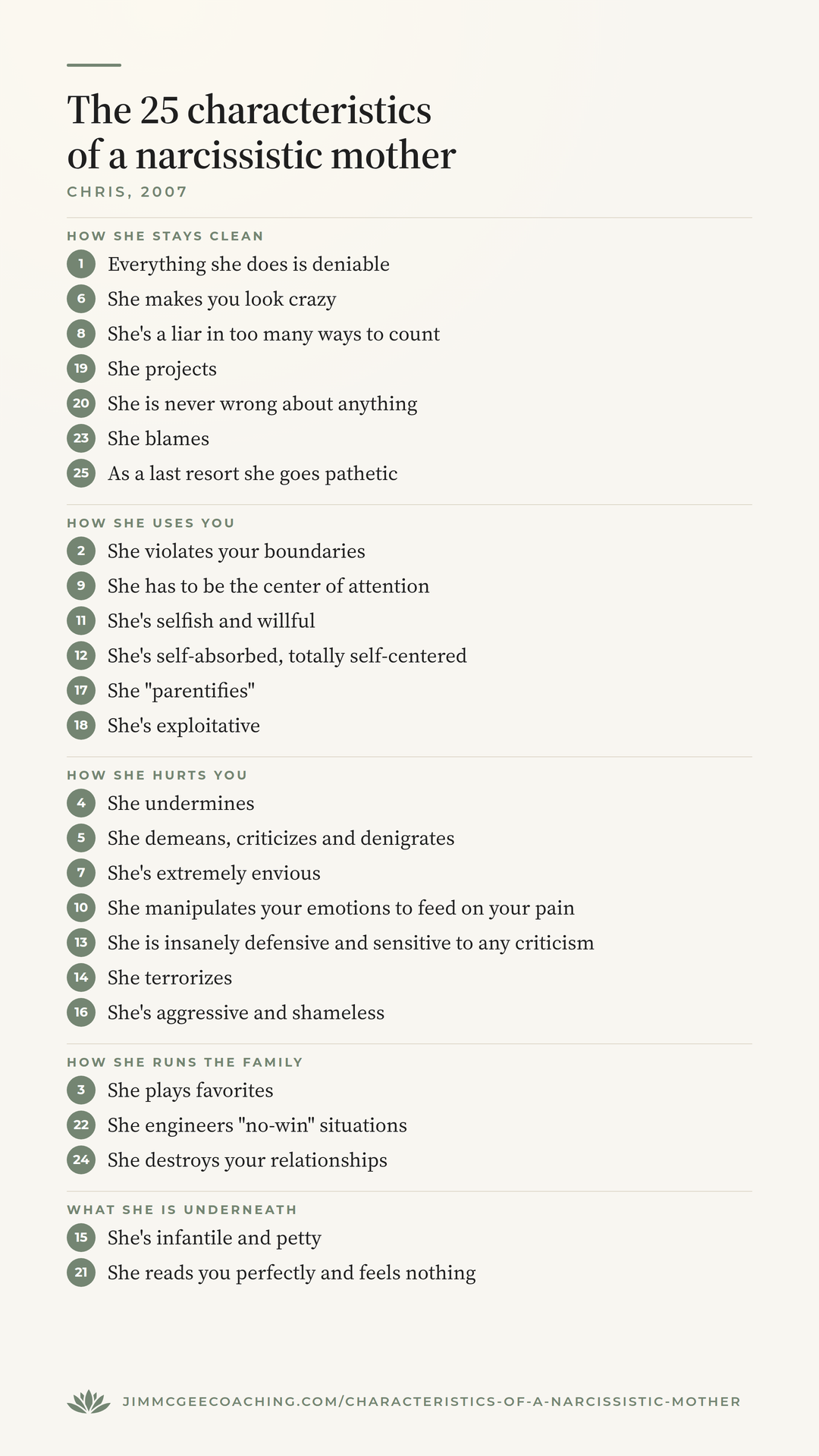
If this is your mother, someone you know needs this list too.
All twenty-five as one image, in the original words and order, with this page on it so they can find the rest.
What the twenty-five add up to
This is not twenty-five behaviors. It is one system, seen from twenty-five angles.
Daniel Shaw describes that system this way: a person who cannot bear her own dependency and shame keeps them out of herself by keeping them in someone else.
Everything on this list serves that. The deniability that keeps her clean. The projection that moves the badness. The blame that makes you agree to hold it. The collapse that punishes you for noticing.
The glossary calls the arrangement relational subjugation. Underneath every move is one purpose: keeping you in the one-down role so she never has to stand there.
Shaw also describes where the children go.
Some internalize it and become the one who carries everything: deflated, apologizing, certain of their own badness. Some adopt her stance instead, and grow up to need someone else to carry it for them.
Both are injuries. Neither was a choice.
And then there is the question underneath this whole page: why is a list this accurate so hard to believe about your own mother?
Emmanuel Ghent had an answer: knowing and taking in are different acts.
Taking it in would mean giving up every picture of her you have. If a perception threatens a belief, one of them has to go, and for a child it was never going to be the belief.
Why this holds on
All of this is hard to believe because it’s not just about her. Fundamental truths about who she is and who you are are in need of an upgrade.
It’s a major upgrade but it’s very disorganizing in a good way. Kids keep the image of their parents as good for very necessary reasons.
However, more accurate beliefs can be incorporated with the right approach.
If you have read this far, agree with most of it, and still feel a “but” somewhere, that is normal.
That is where the work is: not knowing more, but letting what you already know sink in.
What heals, and what it asks
What I have seen matter most for people who grew up this way is this.
The body first. Safety is not an idea. It is a nervous system that stops reading the present as the past, and it comes before any insight can land. The glossary’s entries on nervous system regulation and the window of tolerance are about this.
Nothing you understand on this page will take hold in a body that is still braced for her.
Someone who does not need you to disappear. You cannot do this alone, and that is not a weakness in you; it is how selves get built in the first place.
The work is learning to have your own thoughts and feelings while staying connected to another person, and it is learned with a person who does not require you to go quiet. The glossary calls the capacity differentiation, and self-trust grows back in the same place.
The grief belongs here too. She is alive and absent, and nobody recognizes it as a loss, so you grieve it alone. The glossary’s name for that is disenfranchised grief, and it goes better witnessed than alone.
Attachment can change. People who grew up insecure can become secure, through relationships that keep contradicting what they learned. The researchers call it earned secure attachment, and the studies find these adults doing as well as people who were secure from the start.
What you learned as a child is a prediction, not a destiny.
Asserting yourself can feel, at first, like something terrible will happen. The glossary calls that fear abandonment depression. It is the old prediction firing, not a sign of what will happen now.
Recovery implication
Recovery from this is not about adding anything to you. It is about what was laid over you being lifted, slowly, in relationships that do the opposite of what she did.
The self underneath was never destroyed.
Shaw describes the therapist’s task as loosening the toxic identification “so the Self can get enough air to breathe.”
That is close to how I would describe coaching too. Not building a new person, but making room for the one who had to go quiet.
Frequently asked questions
Who wrote the 25 characteristics of a narcissistic mother?
A survivor writing under the name Chris, in 2007. No surname or credentials were ever attached, and the site that first published the essay is gone. The entire text of Chris’s original post can be read here. The clinical commentary on this page is mine; the list is hers.
Does my mother have to show all 25 characteristics?
No. Chris was describing a pattern at its fullest, and the severe end of it. Recognition in a handful of these, especially the first (deniability), the nineteenth (projection) and the twenty-third (blame), is already meaningful. This page describes patterns; it does not diagnose anyone. The useful question is not “does she qualify” but “what did living with this do to me.”
Chris wrote for daughters. Does this apply to sons?
Yes, with differences in how it lands. A son is less likely to be believed when he complains about his mother, more likely to be drafted as her surrogate partner, and more likely to have his anger used as proof that he is the problem. The envy aimed at him tends to target his freedom and the woman he loves rather than his appearance. I have written about that separately, in Sons of Narcissistic Mothers.
Why can I read this list, agree with every line, and still not quite believe it about her?
Because knowing and taking in are different acts. The analyst Emmanuel Ghent described exactly this: a person who can describe what a parent did in detail and still ends with “somehow I can’t believe it’s true.” Believing it would require rebuilding every other picture of her, and the mind protects that structure before it protects the truth. It is not denial in the lazy sense. It is loyalty, and it loosens slowly, usually in relationship rather than through more reading.
References
Chris’s essay comes first; the sources the commentary rests on follow, roughly in the order the page uses them, with a shorter list for anyone who wants to go deeper.
What this is based on
- Chris (2007). The Narcissistic Mother: Characteristics of Narcissistic Mothers. Originally self-published online; the original site is gone.
- Shaw, D. (2014). Traumatic Narcissism: Relational Systems of Subjugation. Routledge. (The traumatizing narcissist, externalization of shame, hegemony of subjectivity, the child’s double bind.) Find in a library | Taylor & Francis
- Fairbairn, W. R. D. (1952). Psychoanalytic Studies of the Personality. Routledge. (The moral defense: why a dependent child takes the badness inside to keep the parent good.) Find in a library | Taylor & Francis
- Ghent, E. (1990). Masochism, submission, surrender: Masochism as a perversion of surrender. Contemporary Psychoanalysis, 26(1), 108 to 136. (The apperception of disorganizing meaning: knowing without being able to take in.) DOI
- Klein, M. (1946). Notes on some schizoid mechanisms. International Journal of Psychoanalysis, 27, 99 to 110; and Klein, M. (1957). Envy and Gratitude. Tavistock. (Splitting, projective identification, and envy as the impulse to spoil the good.) Find in a library
- Ogden, T. H. (1979). On projective identification. International Journal of Psychoanalysis, 60, 357 to 373. (The three-phase model: projection, interpersonal pressure, enactment.) Find in a library
- Kohut, H. (1972). Thoughts on narcissism and narcissistic rage. The Psychoanalytic Study of the Child, 27(1), 360 to 400. (Narcissistic injury and rage as defense of a fragile self.) DOI
- Winnicott, D. W. (1967). Mirror-role of mother and family in child development. In Playing and Reality (1971). Routledge. (The child who looks at the mother’s face and does not see himself.) Find in a library
- Bateson, G., Jackson, D. D., Haley, J., and Weakland, J. (1956). Toward a theory of schizophrenia. Behavioral Science, 1(4), 251 to 264. (The double bind.) DOI
- Freyd, J. J. (1997). Violations of power, adaptive blindness and betrayal trauma theory. Feminism & Psychology, 7(1), 22 to 32. (DARVO introduced.) DOI
- Harsey, S., and Freyd, J. J. (2020). Deny, attack, and reverse victim and offender (DARVO): What is the influence on perceived perpetrator and victim credibility? Journal of Aggression, Maltreatment & Trauma, 29(8), 897 to 916. (The experimental evidence that the reversal works on observers.) DOI
- Walker, P. (2013). Complex PTSD: From Surviving to Thriving. (Parental contempt, the inner critic as process, emotional flashbacks, turning shame back into blame.) Find in a library | pete-walker.com
- Heller, L., and LaPierre, A. (2012). Healing Developmental Trauma. North Atlantic Books. (The attunement and autonomy survival styles.) Find in a library | North Atlantic Books
- Heller, L., and Niederwieser, S. K. (2026). Healing Shame and Guilt. North Atlantic Books. (Shame as an ongoing process rather than a stored feeling.) Find in a library
- Stark, E. (2007). Coercive Control: How Men Entrap Women in Personal Life. Oxford University Press. (Control as a continuous condition; micro-regulation; the “liberty crime.”) Find in a library
- Porges, S. W. (2011). The Polyvagal Theory. W. W. Norton. (Neuroception: the body’s below-conscious appraisal of safety and threat.) Find in a library
- Boszormenyi-Nagy, I., and Spark, G. M. (1973). Invisible Loyalties. Harper & Row; and Jurkovic, G. J. (1997). Lost Childhoods: The Plight of the Parentified Child. Routledge. (Parentification; the adaptive versus destructive distinction.) Find in a library
- Bowen, M. (1978). Family Therapy in Clinical Practice. Jason Aronson. (Triangles, the family projection process, differentiation of self.) Find in a library
- Fricker, M. (2007). Epistemic Injustice: Power and the Ethics of Knowing. Oxford University Press. (Testimonial injustice: not being treated as a credible knower of your own life.) DOI
- Ritter, K., Dziobek, I., Preissler, S., Rüter, A., Vater, A., Fydrich, T., Lammers, C.-H., Heekeren, H. R., and Roepke, S. (2011). Lack of empathy in patients with narcissistic personality disorder. Psychiatry Research, 187(1 to 2), 241 to 247. (Cognitive empathy preserved, affective empathy impaired.) DOI
- Herman, J. L. (1992). Trauma and Recovery. Basic Books. (Captivity, the three stages of recovery, why the never-trapped judge the trapped.) Find in a library
- Boss, P. (2006). Loss, Trauma, and Resilience: Therapeutic Work with Ambiguous Loss. W. W. Norton. (Grief for someone alive and absent; living inside the truth of what was lost.) Find in a library
- Mahler, M. S., Pine, F., and Bergman, A. (1975). The Psychological Birth of the Human Infant. Basic Books. (Separation-individuation.) Find in a library
Go deeper
- Reid, J. Growing Up as the Scapegoat and How Scapegoats Can Heal from Narcissistic Abuse. Practitioner guidance on the scapegoat role, envy, the apology reflex, and the pressure to be what the narcissist insists you are. jreidtherapy.com
- Mandeville, R. C. (2020). Rejected, Shamed, and Blamed. The scapegoat as the family’s “human movie screen.” Find in a library
- Love, P., and Robinson, J. (1990). The Emotional Incest Syndrome. Bantam. The child drafted as a parent’s surrogate partner. Find in a library
- Knox, J. (2011). Self-Agency in Psychotherapy. W. W. Norton. The child who learns “there is only one mind, the parent’s.” Find in a library
- Nussbaum, M. C. (1995). Objectification. Philosophy & Public Affairs, 24(4), 249 to 291. The seven features of treating a person as a thing. DOI
- Smith, C. P., and Freyd, J. J. (2014). Institutional betrayal. American Psychologist, 69(6), 575 to 587. DOI
- Talmon, A., and Ginzburg, K. (2016). The nullifying experience of self-objectification: The development and psychometric evaluation of the Self-Objectification Scale. Child Abuse & Neglect, 60, 46 to 57. DOI
- Fonagy, P., and Allison, E. (2014). The role of mentalizing and epistemic trust in the therapeutic relationship. Psychotherapy, 51(3), 372 to 380. DOI
- Benjamin, L. S. (2003). Interpersonal Reconstructive Therapy. Guilford Press. How attachment templates persist: the three “copy processes.” Find in a library
- Heller, L., and Kammer, B. J. (2022). The Practical Guide for Healing Developmental Trauma. North Atlantic Books. The origins of disrupted agency and emotional repression. Find in a library
- McBride, K. (2008). Will I Ever Be Good Enough? Healing the Daughters of Narcissistic Mothers. Atria. The daughters’ book, for the readers Chris wrote for. Find in a library
- Malkin, C. (2015). Rethinking Narcissism. HarperWave. Echoism, the mirror image of narcissism. Find in a library
- On this site: the glossary deep dives on adult children of narcissistic parents, the family scapegoat and narcissistic abuse recovery; the entry on maternal narcissism; and, on the blog, Sons of Narcissistic Mothers and 55 things narcissistic mothers say to their sons.
For sons of narcissistic mothers
You tracked her feelings, managed her reactions, and stayed small enough to keep the peace. It worked. It also cost you the part that knew what you wanted, what you felt, who you were underneath the managing.
The guilt that shows up when you put yourself first isn’t a flaw in you. It’s an old loyalty; formed long before you had any choice about it.
NARM-informed coaching works at the level where that loyalty lives. Slowly, relationally, without asking you to blame anyone or perform being fine.
Schedule a Free ConversationPrivate NARM-informed coaching. Not licensed psychotherapy or crisis care.